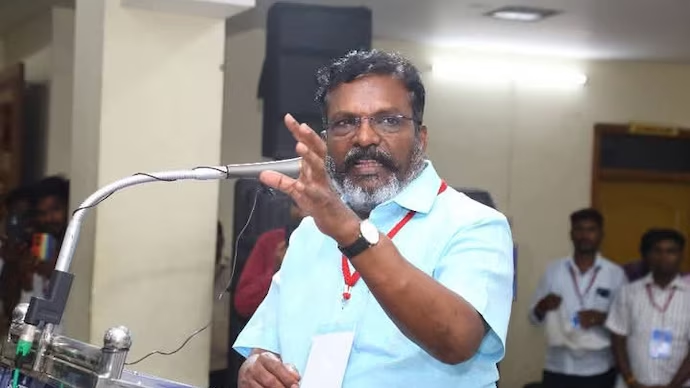
BHARATNEWS / Thol Thirumavalavan on Monday confirmed that discussions had taken place regarding the possibility of him becoming the Chief Minister of Tamil Nadu, but clarified that the conversations were only informal and never reached an official stage.
The remarks come amid intense political speculation following reports that leaders from rival parties had explored the idea of backing the Viduthalai Chiruthaigal Katchi (VCK) chief as a consensus candidate during the post-election political developments in the state.
Speaking after the floor test in the Tamil Nadu Assembly, Thirumavalavan said that only “well-wishers and mediators” had discussed the possibility with him and that no formal political proposal was ever placed before his party.
Political Speculation After Hung Assembly Scenario
The controversy began after comments made by rebel AIADMK leader C Ve Shanmugam, who claimed Tamil Nadu had received a rare opportunity to see a Dalit leader become Chief Minister.
According to Shanmugam, there were discussions involving parties including the DMK and Left groups about supporting Thol Thirumavalavan for the top post. The idea reportedly surfaced during political uncertainty following the Assembly election results, when government formation equations were still fluid.
Although the proposal never moved beyond preliminary conversations, the reports sparked major political debate across Tamil Nadu because it would have marked the first time a Dalit leader became Chief Minister of the state.
VCK’s Role in Government Formation
The Viduthalai Chiruthaigal Katchi had contested the elections as part of a pre-poll alliance with the Dravida Munnetra Kazhagam.
However, after the results, the VCK won two seats and later announced outside support to Tamilaga Vettri Kazhagam, which emerged as the single largest party. The political landscape became increasingly complicated as parties explored possible alliances and support arrangements to prevent instability in the Assembly. ye pade
During that period, reports suggested that some political intermediaries floated Thirumavalavan’s name as a possible compromise Chief Minister candidate to prevent actor-turned-politician Vijay from taking office.
“No Official Approach Was Made”
Responding directly to the speculation, Thol Thirumavalavan stated that while informal conversations happened, no political party officially approached him or his organisation with a concrete proposal.
“Well-wishers and mediators spoke but no one approached officially,” he clarified.
He also revealed that even members within his own party and supporters had discussed the idea and questioned why a Dalit leader could not become Chief Minister in Tamil Nadu. According to him, one of the VCK general secretaries even posted about the possibility on social media, but the party later felt such discussions were inappropriate without formal political developments.
Thirumavalavan added that he first learned about the growing political chatter on the night of May 8 but initially did not treat it seriously.
VCK Extends Outside Support to TVK
The VCK chief reiterated that his party had extended only unconditional outside support to Tamilaga Vettri Kazhagam and had not sought ministerial positions in the government.
“I’ve said that we will not take part in the Cabinet,” he stated, while acknowledging that some party leaders still preferred participation in government. The statement appears aimed at reinforcing the VCK’s independent political identity even while supporting the ruling arrangement from outside.
The party’s position has become politically important because in a tightly contested Assembly, even smaller allies can influence stability and legislative arithmetic.
Debate Over Dalit Representation Returns to Centre Stage
The controversy has once again brought attention to the issue of Dalit representation in Tamil Nadu politics. Reflecting on the social and political environment in the state, Thol Thirumavalavan remarked that caste realities continue to shape political possibilities despite Tamil Nadu’s long-standing image as a centre of social justice politics.
“Tamil Nadu, even if you call it a social justice land or Periyar land, is caught in the grips of casteism. A Dalit cannot become a Chief Minister here that easily,” he said.
His remarks triggered wider conversations about caste representation, political power structures, and whether Tamil Nadu’s Dravidian political model has truly dismantled caste barriers at the highest levels of governance.
Why the Issue Became Politically Sensitive
The possibility of a Dalit Chief Minister carried symbolic as well as political significance.
Tamil Nadu has historically projected itself as a state deeply influenced by the social justice ideology of Periyar E V Ramasamy and the broader Dravidian movement. However, critics have often argued that despite progressive rhetoric, top political leadership in the state has remained concentrated within dominant caste structures.
That is why even informal discussions around Thol Thirumavalavan becoming Chief Minister quickly drew statewide attention. Supporters described the idea as a historic opportunity for social representation, while opponents dismissed it as political manoeuvring during a volatile government formation phase.
DMK and AIADMK Drawn Into Debate
The remarks by rebel AIADMK figures also intensified speculation about behind-the-scenes political negotiations involving the state’s two major Dravidian parties.
Although no official confirmation emerged from the DMK or AIADMK leaderships, claims that ministers from both camps could have supported a Thirumavalavan-led arrangement generated major political curiosity.
The situation became even more dramatic because it unfolded at a time when multiple parties were trying to assess how to respond to the electoral rise of Vijay and the growing influence of TVK. Some political observers believe the discussions reflected broader attempts to prevent a complete restructuring of Tamil Nadu’s traditional political order.
Larger Political Implications
Even though the proposal never materialised, the episode has revealed shifting political equations in Tamil Nadu. The emergence of new players, fractured mandates, and changing alliance dynamics have created a political environment where unconventional possibilities are increasingly being discussed openly. For the VCK, the developments have also elevated its visibility and bargaining power within Tamil Nadu politics.
Meanwhile, the broader debate sparked by Thirumavalavan’s comments may continue to influence conversations around caste, representation, and leadership in the state for some time. Whether or not the discussions were serious, the fact that such an idea entered mainstream political debate itself marks an important moment in Tamil Nadu’s evolving political landscape.