FIFA World Cup : The 2026 FIFA World Cup group stage has already delivered its fair share of high-octane drama, historic milestones, and intense tactical battles, but Group J has fast become the most talked-about pool in the entire tournament. Following the opening round of fixtures, Argentina sits at the summit of the table, closely pursued by a resurgent Austria, while a resilient Jordan and a battered Algeria look to pick up the pieces.
The narrative of the group is currently split down the middle: on one side is the pure footballing genius and accompanying controversy surrounding Lionel Messi, and on the other is the gritty, tactical resilience of European dark horses and Middle Eastern debutants.
The Masterclass and the Mud: Messi’s Polarizing Opener
Argentina entered their title defense under immense scrutiny, tasked with breaking a historical curse—the nation had never successfully won its opening match in a World Cup tournament as defending champions. Standing in their way in Kansas City was a physical, disciplined Algeria side. What ensued was a match that will be remembered for two entirely contrasting reasons: a legendary individual performance and a massive refereeing controversy.
At 38 years old, playing in his record-breaking sixth FIFA World Cup, Lionel Messi looked entirely unburdened by age or pre-tournament injury concerns. He orchestrated the game from a deeper, central midfield role, controlling the tempo and manipulating the Algerian defensive lines with trademark precision. Despite having an early eighth-minute goal chalked off for a razor-thin offside, Messi’s patience paid off.
In the 17th minute, he broke the deadlock with a piece of pure magic, weaving past two defenders at the edge of the box before unleashing a lethal, left-footed strike past Algerian goalkeeper Luca Zidane. He doubled his tally in the 60th minute, showcasing his predatory instincts by sliding home a rebounded shot from Alexis Mac Allister. The piece de resistance came in the 76th minute—a flawless give-and-go with Mac Allister, finished with a classic curled shot into the bottom corner to complete his hat-trick.
With this performance, Messi drew level with Germany’s Miroslav Klose as the all-time top scorer in World Cup history with 16 goals, precisely 20 years to the day after scoring his first tournament goal in 2006. He also became the oldest player to score a hat-trick in the competition’s history.
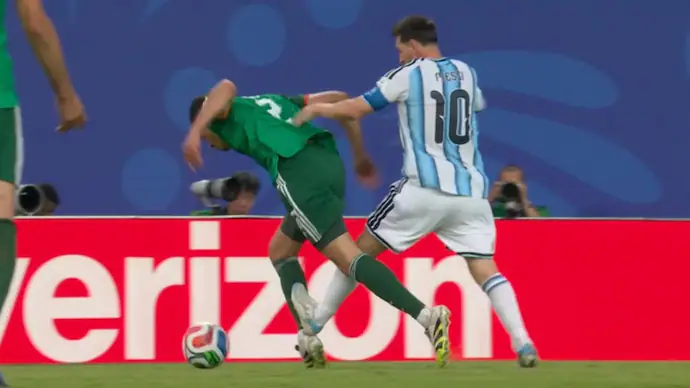
However, the brilliance was almost eclipsed by a flashpoint in the 32nd minute. As Algeria captain Aissa Mandi stepped across to shield a loose ball, Messi caught him from behind, his studs landing directly on Mandi’s trailing calf and Achilles tendon. Mandi crumpled in agony, but Polish referee Szymon Marciniak waved play on, and the Video Assistant Referee (VAR) completely ignored the incident.
The lack of even a yellow card triggered a massive global debate. Pundits and fans instantly accused the officials of giving the Argentine captain “special treatment,” arguing that any lesser-known player would have received a straight red card for serious foul play. While Messi’s camp argued the contact was an incidental, high-speed collision, the controversy has left a lingering cloud over Argentina’s emphatic 3-0 victory.
Austria Grinds Out Vital Points Against Spirited Jordan
Meanwhile, in Santa Clara, the other half of Group J kicked off with a fiercely competitive clash between Austria and tournament debutants Jordan. Austria, making their highly anticipated return to the World Cup stage after a 28-year absence, were heavily favored, but they were pushed to their absolute limits by a courageous Jordanian side.
The match began at a frantic pace, with Jordan flexing their counter-attacking prowess just two minutes in when captain Ehsan Haddad forced a shot into the side netting. Austria settled their nerves in the 21st minute through a spectacular long-range thunderbolt from Romano Schmid, who found the top corner from well outside the penalty area.
Far from being intimidated, Jordan used the blistering pace of forwards Mousa Al-Tamari and Ali Olwan to dismantle the Austrian high press. Five minutes into the second half, Olwan executed a brilliant solo run down the left flank, cutting inside to curl a magnificent shot in off the far post, registering a historic first-ever World Cup goal for his country.
With the game deadlocked at 1-1 and Austria looking vulnerable, manager Ralf Rangnick turned to his bench, introducing 37-year-old veteran striker Marko Arnautovic at halftime. The substitution proved to be the masterstroke of the match. Arnautovic’s physicality immediately disrupted Jordan’s low defensive block. Although he had a close-range goal disallowed for an accidental handball by teammate Stefan Posch following a lengthy VAR review, his presence remained a constant menace.
The decisive breakthrough came in the 76th minute. Swung in by Marcel Sabitzer, a sharp Austrian corner created chaos in the six-yard box. Under immense pressure from Arnautovic, Jordanian defender Yazan Al-Arab inadvertently deflected the ball into his own net.
As Jordan thrown everyone forward in search of another equalizer deep into stoppage time, Austria caught them on a break, winning a penalty 12 minutes into added time. Arnautovic stepped up and calmly converted the spot-kick, sealing a grueling 3-1 victory that flattered the Europeans but secured three crucial points.
Group J Standings & The Road Ahead
Following the conclusion of the thrilling opening round, the hierarchy of Group J is starting to take shape, though the competitive nature of all four teams suggests that qualification is far from decided.
| Position | Team | Played | Won | Goal Difference | Points |
| 1 | Argentina | 1 | 1 | +3 | 3 |
| 2 | Austria | 1 | 1 | +2 | 3 |
| 3 | Jordan | 1 | 0 | -2 | 0 |
| 4 | Algeria | 1 | 0 | -3 | 0 |
The upcoming second round of fixtures promises even higher stakes. Argentina will look to secure their spot in the knockout stages as they face an incredibly disciplined Austria side in a match that will test the Albiceleste’s defensive resolve against a relentless high-pressing system.
Concurrently, Algeria and Jordan will square off in a must-win Mediterranean-Middle Eastern derby. For Algeria, they must find a way to recover mentally from the Messi storm, while Jordan will lean on the optimism of Ali Olwan, who firmly believes his team has the quality to bounce back and qualify. With tactical drama, individual brilliance, and lingering controversies, Group J is shaping up to be the absolute crown jewel of the 2026 World Cup group stages.