
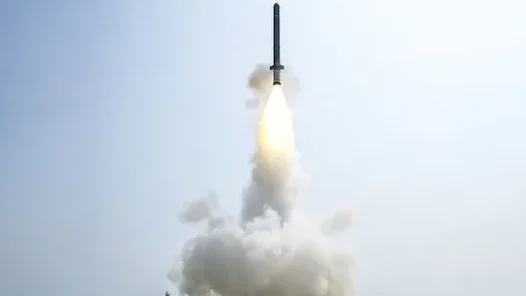
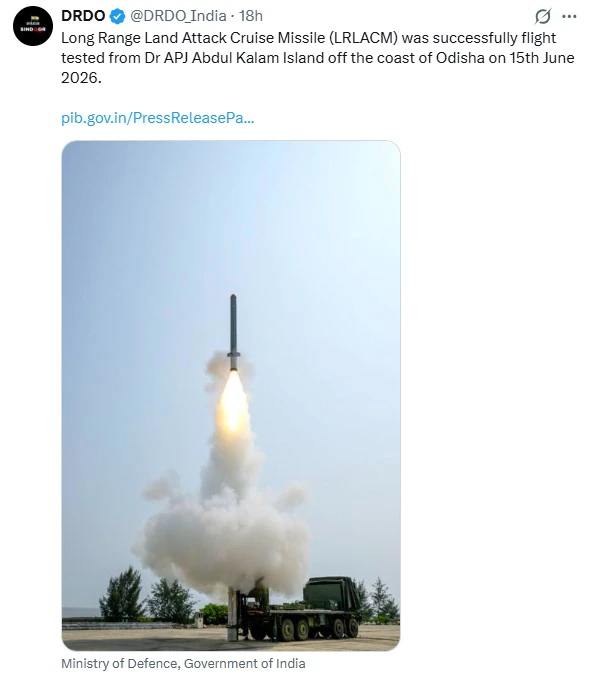
New Delhi : In a major milestone for India’s defense sector, the Defence Research and Development Organisation (DRDO) successfully conducted the maiden flight-test of its indigenously developed Long Range Land Attack Cruise Missile (LRLACM) on Monday. The trial, executed from Dr. APJ Abdul Kalam Island off the coast of Odisha, met all technical and operational objectives, validating the weapon system’s propulsion, low-altitude navigation, and precise warhead delivery.
The development has drawn immediate global attention, with defense analysts labeling the LRLACM as India’s equivalent to the United States’ iconic Tomahawk cruise missile. This breakthrough significantly bridges the gap in India’s long-range precision-strike capabilities, providing the country with a potent, low-flying standoff weapon capable of altering the strategic balance on both its western and northern fronts.
The Evolution: Out of the Nirbhay Shadow
The LRLACM project marks a massive technological victory for India’s domestic defense ecosystem, running under the ‘Aatmanirbhar Bharat’ (self-reliant India) banner. The initiative is a direct, highly upgraded successor to the older Nirbhay cruise missile program. While the Nirbhay initiative suffered a string of high-profile development and flight-test failures after 2016, the LRLACM features vastly improved guidance packages, highly advanced navigation algorithms, and superior hardware reliability.
The Aeronautical Development Establishment (ADE) based in Bengaluru served as the nodal laboratory for this project, working in lockstep with multiple DRDO labs and domestic private industry partners. Moving forward, the missile is being customized to seamlessly integrate into all three branches of the military: the Indian Army, Navy, and Air Force. Though the initial flight test was a complete “textbook success,” defense officials indicate that a formal induction into active military service remains roughly two years away, pending successive configuration and user-acceptance trials.
How the Desi Tomahawk Redefines Threat Detection
The comparison to the American Tomahawk stems from the LRLACM’s design as a high-subsonic cruise missile. Unlike traditional ballistic missiles—which shoot high into outer space along a predictable arc, making them visible to long-range early warning radars—the LRLACM operates entirely differently.
- Terrain-Hugging Profiles: The missile drops to extremely low, radar-evading altitudes shortly after launch, mimicking the contours of the landscape beneath it.
- Radar Avoidance: By flying beneath the detection envelopes of conventional radar arrays and capitalizing on ground clutter, the missile can effortlessly bypass advanced integrated air defense systems.
- Pinpoint Accuracy: Backed by an advanced mission-tailored guidance system, the missile maintains the agility to alter its direction mid-flight, navigate around terrain obstacles, and strike localized, high-value assets with absolute precision.
Modern conflicts, including the current localized wars in Europe and the Middle East, have heavily emphasized the decisive role of long-range standoff weapons. The US military’s recent reliance on Tomahawk strikes across strategic locations highlighted how world powers utilize these systems to dismantle hostile targets from thousands of miles away without risking human pilots. The LRLACM guarantees India an identical, self-sufficient capability.
Redrawing the Strategic Map: Pakistan and China in Focus
While the Ministry of Defence has remained tight-lipped regarding the exact performance metrics, defense intelligence estimates pin the LRLACM’s effective operational range between 1,000 and 1,500 kilometers. When combined with its platform flexibility—the ability to be launched from mobile ground vehicles, frontline warships, and submarines—this range fundamentally shifts regional deterrence.
       [ LRLACM STRIKING RANGE ENVELOPE: 1,000 - 1,500 KM ]

          WESTERN SECTOR                    NORTH/EAST SECTOR
       ====================                ====================
       * Islamabad & Rawalpindi            * Lhasa (Tibet Hub)
       * Lahore & Faisalabad               * Chengdu (Military HQ)
       * Karachi (Naval Base)              * Kunming & Urumqi
On the western front, a naval deployment of the LRLACM in the Arabian Sea or an army deployment along forward border positions effectively covers the entirety of Pakistan. Critical political, economic, and military command hubs—including Islamabad, the military headquarters at Rawalpindi, Lahore, and the massive southern naval port city of Karachi—fall well within the missile’s crosshairs.
More crucially, the system changes the equation along the Line of Actual Control (LAC) with China. If positioned across the northern or eastern theaters, the LRLACM places vital deep-tier Chinese military infrastructure under direct threat. Strategic target zones include Lhasa in Tibet, the major regional military hub of Chengdu, the logistics nodes of Kunming, and the key infrastructure grids within Urumqi.
Cost-Effective Strategic Deterrence
Beyond tactical deployment, the indigenous nature of the project provides India with a distinct economic edge. A single American Block IV Tactical Tomahawk is an incredibly expensive asset, costing the US military approximately $1.3 million (roughly ₹11.30 crore). Because India has built the LRLACM from the ground up using local sub-systems, domestic production costs are projected to be significantly lower, allowing for massive production scaling.
Furthermore, the versatility of the platform ensures that it can carry either heavy conventional high-explosive payloads for tactical dominance or nuclear warheads for strategic deterrence. By giving India the upper hand to project precision power safely away from hostile border zones, the LRLACM has firmly established itself as a cornerstone of India’s future military doctrine.