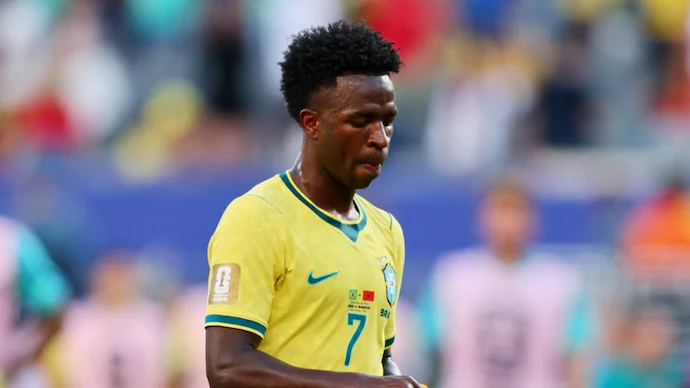
FIFA World Cup New Jersey, June 14: Brazil’s quest for a record-extending sixth FIFA World Cup title began on an underwhelming note as Carlo Ancelotti’s side were held to a 1-1 draw by Morocco in a fiercely contested Group C clash at the FIFA World Cup 2026. While Vinicius Junior produced a moment of brilliance to rescue a point for the five-time world champions, Morocco once again proved why they are regarded as one of the most dangerous teams in international football.
The match marked Ancelotti’s first World Cup outing as Brazil head coach, and expectations were sky-high. Fans hoped to see the traditional Brazilian flair and attacking football that has defined generations of Selecao teams. Instead, they witnessed a disciplined Moroccan side frustrate Brazil for long periods and expose several weaknesses that the South American giants will need to address quickly.
Morocco Continue Their Rise on the Global Stage
Morocco arrived at the tournament carrying momentum from their historic run to the semi-finals of the 2022 FIFA World Cup. Far from being considered underdogs, the Atlas Lions entered the competition with genuine ambitions of another deep run.
They showed that confidence from the opening whistle. Morocco pressed aggressively, moved the ball with purpose and looked more comfortable in possession than their illustrious opponents during the early stages.
Their reward came in the 21st minute when Brahim Diaz split the Brazilian defense with an incisive pass. Ismael Saibari timed his run perfectly before calmly lifting the ball over goalkeeper Alisson Becker to give Morocco a deserved lead.
The goal sparked wild celebrations among Moroccan supporters and highlighted the tactical discipline that has become a hallmark of the team in recent years.
Brazil Struggle to Find Their Rhythm
For much of the first half, Brazil looked surprisingly disjointed.
Despite boasting world-class talent including Vinicius Junior, Raphinha, Bruno Guimaraes and Casemiro, the team struggled to control the midfield battle. Passes went astray, possession was surrendered cheaply and Morocco consistently found space to launch dangerous counterattacks.
Ancelotti spent large periods pacing the touchline, attempting to reorganize his side and inject some urgency into their play. Gradually, Brazil began to settle and enjoy longer spells of possession.
However, they still lacked the fluidity and creativity that fans associate with the famous yellow shirt.
Vinicius Junior Produces a Magical Equaliser
Just when Brazil appeared to be running out of ideas, Vinicius Junior delivered a moment worthy of the occasion.
Receiving the ball near the edge of the penalty area, the Real Madrid star unleashed a stunning strike that flew past the Moroccan goalkeeper and into the net. The goal instantly changed the atmosphere inside the stadium and reminded everyone why Vinicius is regarded as one of the world’s elite attackers.
It was a moment of individual brilliance rather than a product of sustained team play, but it was enough to restore parity before halftime.
The equaliser also ensured Brazil entered the break with renewed confidence after being second-best for much of the opening half.
Tactical Battle Dominates Second Half
If the first half was full of energy and attacking intent, the second period turned into a much more cautious affair.
Both teams became increasingly organized defensively, limiting clear-cut chances and forcing the match into a tactical contest. Morocco remained compact and disciplined, refusing to allow Brazil’s forwards the space they craved.
Brazil enjoyed more possession after the break but struggled to translate that dominance into meaningful opportunities. While Vinicius and Raphinha occasionally threatened, Morocco’s defensive structure rarely looked vulnerable.
As the game progressed, it became clear that neither side was prepared to take excessive risks in pursuit of victory.
Ancelotti’s Selection Questions
One of the major talking points was Ancelotti’s decision to start Igor Thiago as the central striker.
The Brentford forward earned his place after an impressive season in club football, but he found life difficult against Morocco’s experienced central defenders. His movement was energetic, yet he struggled to establish any real chemistry with Vinicius and Raphinha.
Interestingly, Brazil looked more dangerous after Matheus Cunha entered the match.
The Manchester United forward brought greater mobility and urgency to the attack, immediately causing problems for Morocco’s back line. Several of Brazil’s most promising attacking moves came following his introduction, and his performance may give Ancelotti something to consider ahead of the next group match.
Neymar’s Absence Felt Deeply
Although Brazil possess immense attacking talent, the absence of Neymar was noticeable throughout the contest.
Still recovering from injury, the Brazilian superstar was unavailable for selection. Without him, Brazil often lacked a player capable of controlling the tempo, linking midfield and attack, and maintaining possession under pressure.
The team had pace, dribbling ability and technical quality, but it frequently appeared rushed in crucial moments. Neymar’s creativity and composure might have provided the missing ingredient against a well-organized Moroccan defense.
What the Result Means
At full-time, a draw felt like a fair outcome.
Morocco deserved credit for a disciplined and tactically mature performance, while Brazil improved after a sluggish start but never fully imposed themselves on the game. The result leaves Group C finely balanced and reinforces Morocco’s growing reputation as a genuine force on the international stage.
For Brazil, the opening match has raised important questions. Ancelotti’s side remain among the tournament favourites, but tougher challenges may lie ahead. If Morocco’s midfield and defensive organization caused so many problems, future encounters against elite teams could prove even more demanding.
The World Cup journey is far from over, but Brazil’s pursuit of a sixth star has begun with a reminder that reputation alone guarantees nothing on football’s biggest stage.