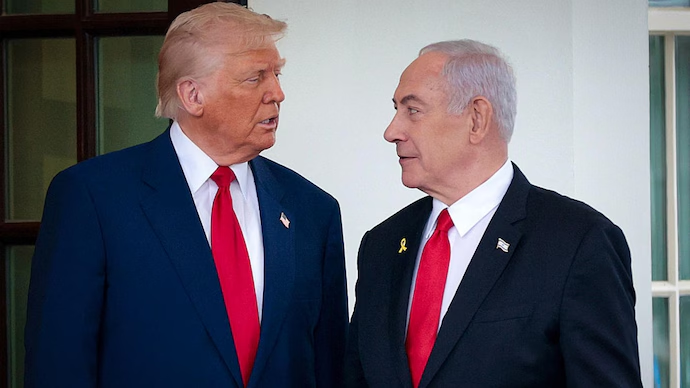
WORLD / The United States has renewed its focus on Greenland, with President Donald Trump’s special envoy calling for Washington to restore a larger military and strategic presence on the Arctic island. The remarks have once again placed Greenland at the centre of growing geopolitical competition in the Arctic, while also triggering concerns in both Greenland and Denmark over sovereignty and foreign influence.
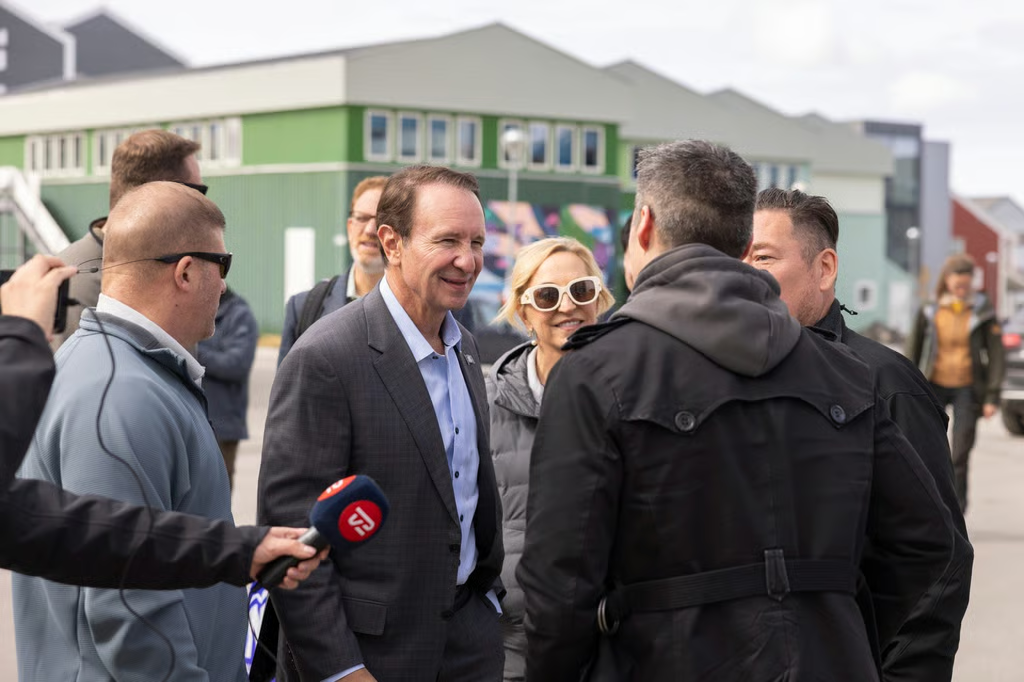
US special envoy Jeff Landry made the comments during his first official visit to Greenland since being appointed in December 2025. Although the trip was not formally invited by Greenlandic authorities, it highlighted Washington’s increasing interest in the strategically important Arctic territory.
Speaking in Greenland’s capital Nuuk, Landry said it was time for the United States to “put its footprint back on Greenland”, arguing that the island had become increasingly important for American national security.
During the Cold War, the United States operated as many as 17 military facilities across Greenland. Over the decades, however, most of those installations were shut down, leaving only the Pituffik Space Base in northern Greenland operational today.
Trump has repeatedly argued that Greenland is essential to US security interests because of its geographic position between North America and Russia. The Arctic island lies along one of the shortest missile routes between the two countries, making it strategically valuable in any future military confrontation.
Apart from defence concerns, Greenland is also attracting international attention because of its vast natural resources. Scientists believe the island contains large reserves of rare earth minerals, which are critical for modern technologies including electric vehicles, batteries, semiconductors and military equipment.
As Arctic ice continues melting due to climate change, new shipping routes are also opening across the polar region. These routes could significantly reduce travel times between Asia, Europe and North America, increasing Greenland’s geopolitical importance even further.
Landry suggested that Washington was considering rebuilding parts of its former military network on the island. According to recent reports, the United States wants to establish three additional bases in southern Greenland.
Under a defence agreement signed in 1951 and updated in 2004, the United States already has the legal right to expand military deployments and infrastructure in Greenland, provided Denmark and Greenland are informed in advance.
The renewed US interest comes after months of controversy surrounding Trump’s statements about Greenland. Earlier this year, Trump revived his long-standing argument that the United States should gain greater control over the territory, claiming it was necessary to counter the growing influence of China and Russia in the Arctic.
Although Trump later stepped back from direct threats to seize Greenland, his remarks created diplomatic tensions with both Denmark and Greenland. In response, a joint working group involving US, Danish and Greenlandic officials was established to discuss security concerns and future cooperation.
Greenlandic leaders have consistently stressed that the island’s future can only be decided by Greenlanders themselves.
Prime Minister Jens-Frederik Nielsen acknowledged that the US security concerns could not simply be ignored, but he criticised the tone of some American statements. Speaking during an economic forum, Nielsen said attempts to “secure control” over Greenland were disrespectful, even if dialogue remained necessary.
Landry met both Nielsen and Greenland’s Foreign Minister Mute Egede during his visit. Greenlandic officials described the talks as constructive, though they noted that the US position appeared unchanged.
The visit itself sparked controversy because Landry arrived without a formal invitation from Greenlandic authorities. Many local politicians and citizens viewed the trip as an attempt by Washington to pressure Greenland into closer alignment with American strategic goals.
Adding to the criticism was the presence of a US doctor travelling with the delegation. The doctor reportedly said he was assessing Greenland’s healthcare needs, a move that drew backlash from Greenlandic officials.
Health Minister Anna Wangenheim criticised the visit sharply, saying Greenlanders should not become “guinea pigs in a geopolitical project”.
The controversy reflects broader concerns in Greenland about becoming caught between competing global powers. While the island has a population of only around 57,000 people, its location and resources have made it increasingly important in global politics.
China has shown growing interest in Arctic investment projects in recent years, while Russia continues expanding its military presence across the Arctic region. This has intensified American concerns about maintaining influence in Greenland.
At the same time, many Greenlanders are debating their long-term political future. Polls show that a majority support eventual independence from Denmark, though there is little support for immediate separation because Greenland’s economy remains heavily dependent on Danish financial assistance.ye pade
Landry attempted to appeal to Greenlandic independence aspirations during an interview with local newspaper Sermitsiaq. He argued that economic cooperation with the United States could help Greenland reduce its dependence on Denmark and eventually achieve greater self-sufficiency.
According to Landry, Greenland possesses significant economic opportunities that could support long-term independence if properly developed. He suggested the United States would support efforts to strengthen Greenland’s economy through investment and cooperation.
However, critics remain sceptical of Washington’s intentions. Many Greenlandic politicians fear that growing American involvement could undermine local autonomy or turn the island into a geopolitical battleground between major powers.
The debate also highlights the Arctic’s rapidly changing importance in international politics. Climate change is transforming the region from a remote frozen frontier into a strategically critical zone for trade, energy, minerals and military competition.
Experts believe tensions surrounding Greenland are likely to continue as global powers compete for influence in the Arctic. For Greenland, balancing economic development, national identity and foreign pressure may become one of its biggest political challenges in the years ahead.