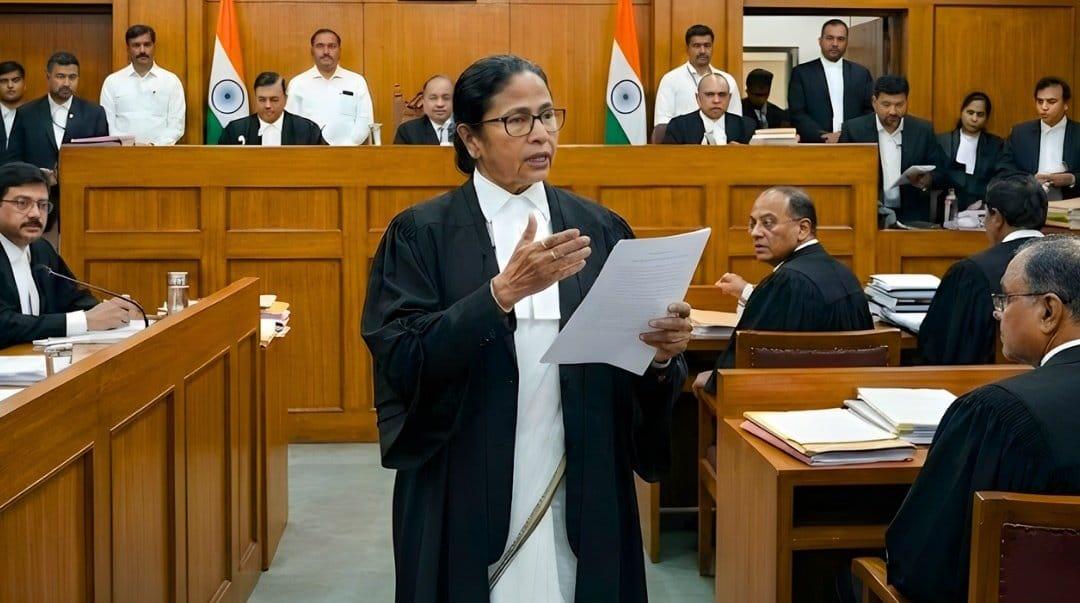

BHARATNEWS / In a significant observation with far-reaching implications for cases under the Unlawful Activities (Prevention) Act (UAPA), the Supreme Court on Monday reiterated that the principle of “bail is the rule and jail is the exception” continues to apply even under stringent anti-terror laws.
The remarks came as the apex court expressed serious reservations about an earlier judgment that denied bail to former JNU student leader Umar Khalid in the 2020 Delhi riots conspiracy case. The court observed that a binding precedent laid down by a larger bench in 2021 was not properly considered while rejecting Khalid’s bail plea earlier this year.
The development is being viewed as an important constitutional reaffirmation of personal liberty and due process, especially in cases involving prolonged incarceration without trial.
Supreme Court Questions Earlier Bail Rejection
A bench comprising Justice BV Nagarathna and Justice Bhuyan made the observations while granting bail to Syed Iftikhar Andrabi, an accused in a separate UAPA case related to alleged terror funding through narcotics trafficking.
During the hearing, the bench reflected on the January 2026 judgment in which the Supreme Court had denied bail to Umar Khalid and Sharjeel Imam in the Delhi riots conspiracy case.
The judges noted that the earlier ruling appeared inconsistent with the principles laid down in the landmark 2021 judgment in Union of India vs KA Najeeb, which held that constitutional courts can grant bail in UAPA cases if prolonged incarceration and delays in trial violate the accused person’s fundamental rights.
Justice Bhuyan underlined that judicial discipline requires smaller benches to follow decisions delivered by larger benches. According to the court, if a bench disagrees with a precedent set by a larger bench, it must refer the matter to an even larger bench rather than dilute or bypass the earlier ruling.
“Bail is the Rule, Jail the Exception”
The bench strongly reaffirmed the long-standing constitutional principle that deprivation of liberty before conviction should remain an exception, not the norm. “Therefore, we have no manner of doubt in stating that even under the UAPA, bail is the rule and jail is the exception,” the court observed.
This statement is particularly significant because Section 43D(5) of the UAPA imposes extremely strict conditions on granting bail. Under the provision, courts are expected to deny bail if accusations appear “prima facie true.”
However, the Supreme Court clarified that such statutory restrictions cannot completely override Article 21 of the Constitution, which guarantees personal liberty and the right to a fair and speedy trial. The court essentially signaled that anti-terror legislation, despite its severity, cannot be interpreted in a manner that converts pre-trial detention into indefinite punishment.
Importance of the KA Najeeb Judgment
The Supreme Court’s observations heavily relied on the 2021 judgment in Union of India vs KA Najeeb, which has increasingly become central to debates around UAPA bail jurisprudence. In that case, a three-judge bench held that constitutional courts possess the authority to grant bail when there is an unreasonable delay in trial proceedings, even if the accused faces charges under stringent laws like the UAPA.
The court had then recognised that keeping an individual incarcerated for years without conclusion of trial could violate fundamental rights. On Monday, the bench stated that the earlier ruling denying bail to Umar Khalid failed to properly apply the principles established in KA Najeeb.
This observation could have wider implications for numerous pending UAPA cases across the country where accused persons have remained in jail for extended periods awaiting trial.
Court Warns Against “Punitive” Pre-Trial Detention
One of the strongest parts of the ruling was the court’s criticism of what it described as an overly restrictive approach to bail under the UAPA.
The judges rejected the so-called “two-prong test” adopted in another case involving Gurwinder Singh. Under that approach, bail could be granted only if the accused successfully demonstrated that the prosecution’s case lacked merit at the preliminary stage. The Supreme Court warned that such a standard could effectively ensure indefinite incarceration because the prosecution only needs to meet a relatively low threshold to establish a prima facie case. ye pade
The bench cautioned that if courts continue applying such reasoning rigidly, then undertrials may remain imprisoned for years regardless of delays in trial proceedings.
According to the court, this risks turning pre-trial detention into a form of punishment before conviction. The judges stressed that the criminal justice system must preserve the distinction between an accused person and a convicted individual.
Background of the Umar Khalid Case
Umar Khalid was arrested in September 2020 in connection with the alleged larger conspiracy behind the February 2020 Delhi riots.
The Delhi Police alleged that speeches delivered during protests against the Citizenship Amendment Act (CAA) formed part of a planned conspiracy that eventually led to communal violence in the national capital. Khalid was charged under several provisions of the Indian Penal Code along with sections of the stringent UAPA.
Investigating agencies claimed he played a key conspiratorial role in the violence. Khalid has consistently denied the allegations and maintained that he was not present in Delhi during the riots. In January 2026, the Supreme Court denied bail to both Khalid and Sharjeel Imam, while granting relief to five other accused persons including Gulfisha Fatima and Meeran Haider.
At the time, the court held that Khalid and Imam stood on a “qualitatively different footing” because of allegations suggesting a more central role in the conspiracy.
Wider Impact on UAPA Cases
Legal experts believe Monday’s observations could influence several pending bail applications under the UAPA.
Many accused individuals in terror-related or conspiracy cases have spent years behind bars without completion of trial proceedings. The Supreme Court’s renewed emphasis on personal liberty and speedy trials may provide stronger grounds for seeking bail in such matters. The ruling also revives an important constitutional debate: how to balance national security concerns with individual freedoms guaranteed under the Constitution.
While the judiciary has repeatedly acknowledged the seriousness of terror-related offences, it has also warned against prolonged incarceration without trial becoming routine. The latest observations suggest the Supreme Court is attempting to restore that balance.
Constitutional Rights vs Stringent Laws
The case once again highlights the tension between special criminal laws and constitutional protections.
The UAPA was enacted to deal with terrorism and activities threatening national security. Over the years, however, critics have argued that its strict bail provisions make it extremely difficult for accused persons to secure release even before trial begins.
Supporters of the law argue that extraordinary offences require extraordinary legal mechanisms. Critics counter that delays in trial and prolonged detention can undermine the presumption of innocence.
The Supreme Court’s latest remarks indicate that constitutional protections under Article 21 cannot be sidelined indefinitely, regardless of the seriousness of allegations. By reiterating that “bail is the rule and jail is the exception,” the court has reinforced the principle that liberty remains central to India’s constitutional framework.
A Significant Judicial Signal
Although the court did not directly reopen the earlier judgment denying bail to Umar Khalid, its observations carry considerable legal and political significance. The remarks effectively question whether courts have become excessively restrictive in interpreting bail provisions under anti-terror legislation.
The ruling may now shape future legal arguments not only in Delhi riots-related cases but also in broader UAPA litigation nationwide.
For now, the Supreme Court’s message appears clear: stringent laws cannot become a justification for endless incarceration without trial, and constitutional courts retain the duty to protect personal liberty even in the most serious criminal cases.