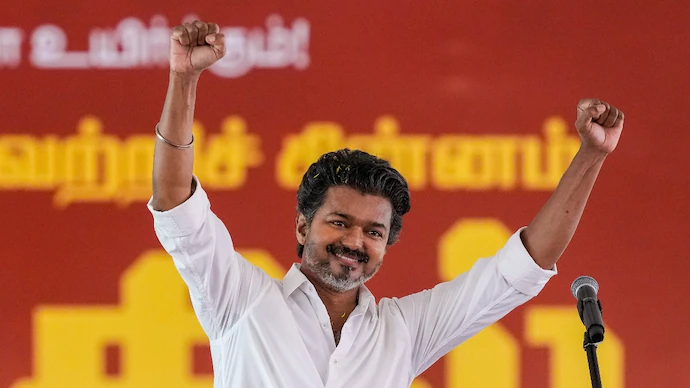
BHARATNEWS / In Tamil Nadu, cinema and politics have always shared a complicated, emotional, and deeply influential relationship. From M. G. Ramachandran to J. Jayalalithaa, the state has repeatedly seen film stars transform into political forces powerful enough to reshape public life. Now, Vijay appears to be walking that same path — but in a way that feels uniquely cinematic.
His recent decision to push for the closure of liquor shops near temples and schools has sparked intense discussion across Tamil Nadu. On the surface, it looks like a straightforward policy position focused on public welfare and social responsibility. But for anyone familiar with Vijay’s filmography, especially his blockbuster film Master, the move feels strangely familiar — almost like fiction slowly turning into reality.
This is why Vijay’s latest political action has resonated so strongly with his fans and even with neutral observers. It does not feel like a celebrity suddenly trying to become socially conscious for political mileage. Instead, it feels like a continuation of themes he has explored on screen for years.
The “Master” Connection Everyone Noticed
In Master, Vijay played JD, a flawed but charismatic college professor who initially appears irresponsible and disconnected from society’s deeper problems. JD drinks heavily, avoids accountability, and lives life with a carefree attitude. The film’s first half presents him as entertaining but emotionally directionless.
But Master is not really about alcohol or rebellion. It is about transformation.
As the story progresses, JD slowly realizes the scale of corruption and exploitation happening around him, especially involving vulnerable children trapped inside a brutal juvenile correction system. At that point, the character changes completely. He does not simply reform himself quietly. He decides to challenge the entire system that allows injustice to continue. ye pade
That transformation became one of the defining emotional arcs of the movie. And now, many people feel Vijay’s real-life political decisions are carrying that same energy.
His anti-liquor move is not about imposing a complete alcohol ban across the state. Instead, it focuses on limiting accessibility near sensitive public spaces like schools and temples. Politically, it is a measured step. Symbolically, however, it sends a much larger message.
Why the Move Matters Politically
Liquor politics in Tamil Nadu has always been complicated. The state-run TASMAC network generates massive revenue for the government, but it has also faced criticism for years over alcoholism, social damage, and easy accessibility.
For many families, TASMAC shops represent more than just alcohol sales. They are often linked to domestic violence, financial distress, addiction, and public nuisance. Complaints about liquor shops operating near schools, colleges, residential areas, and religious places have repeatedly surfaced over the years.
Vijay’s intervention directly taps into that emotional frustration.
Instead of taking an extreme position demanding total prohibition — which is politically risky and economically difficult — he has chosen a more strategic approach. By targeting liquor shops near temples and schools, he is focusing on places associated with morality, childhood, education, and spirituality.
That is why the move feels powerful despite being limited in scope.
It changes the visual and social message.
A liquor shop beside a school normalizes alcohol consumption for young students. A liquor outlet near a temple creates tension between commerce and cultural values. Vijay’s political messaging appears designed to challenge that normalization. And that is exactly why people are comparing it to Master.
Vijay’s Films Have Always Fought “Systems”
One reason Vijay’s political image feels believable is because his movies have consistently revolved around broken systems and institutional failures.
In Mersal, he attacked corruption and exploitation in the healthcare sector. The film questioned why ordinary citizens should suffer because of profit-driven medical systems. In Kaththi, the focus shifted toward corporate exploitation and the struggles of farmers. Vijay portrayed a character fighting powerful business interests that threatened vulnerable communities.
In Sarkar, the central theme became voter awareness and political accountability. The film encouraged people to take democracy seriously and challenge political manipulation. Then came Master, where the battle became deeply personal — a man first confronting his own weaknesses before confronting society’s corruption.
This pattern matters because it means Vijay’s political messaging is not appearing out of nowhere. Audiences have already spent years associating him with stories about reform, justice, and resistance. That gives him an advantage many celebrity politicians struggle to achieve: narrative consistency.
A Political Persona Already Built by Cinema
In politics, authenticity matters. Voters often reject celebrities who suddenly change their personalities to appear politically relevant. But Vijay’s transition feels smoother because his public image was already shaped around social themes.
His films built a specific emotional contract with audiences:
- challenge corrupt systems,
- protect ordinary people,
- stand against exploitation,
- and disrupt harmful structures.
Now, when he talks about liquor accessibility or public welfare, supporters do not see a completely new version of Vijay. They see an extension of the persona they have followed for decades. That emotional familiarity is powerful in Tamil Nadu politics, where cinema has historically shaped public imagination.
For many fans, Vijay is not “acting” political. He is simply continuing the same fight in a different arena.
Symbolism Over Extremism
Another reason this anti-liquor move is gaining traction is because it avoids extreme rhetoric. Vijay is not calling for sudden statewide prohibition. He is not attacking individuals who consume alcohol. Instead, he is targeting placement and accessibility.
That distinction matters.
A complete alcohol ban can create economic complications, black markets, and enforcement challenges. But restricting liquor shops near schools and temples feels more practical and socially acceptable.
It also helps Vijay position himself as a thoughtful reformer rather than a reactionary populist. The move communicates discipline without sounding authoritarian.
In many ways, it reflects the strategy used by JD in Master. The character does not magically erase crime overnight. He disrupts the environment that allows exploitation to flourish. Similarly, Vijay’s political messaging appears focused on disrupting harmful social patterns rather than making impossible promises.
The Emotional Power of “Crowd-Readable Politics”
One of Vijay’s biggest strengths has always been understanding mass communication.
His films are built around emotionally direct moments — scenes that instantly connect with audiences without requiring complicated explanation. Political analysts often describe this as “crowd-readable” messaging.
His anti-liquor move fits that perfectly. Anyone can immediately understand the symbolism:
- schools represent the future,
- temples represent values,
- liquor shops near those spaces feel inappropriate.
The message is simple, visual, emotional, and highly shareable. Modern politics increasingly depends on moments that can spread quickly through social media clips, headlines, memes, and public discussion. Vijay’s move checks every one of those boxes.
That is why the debate exploded online almost instantly.
Fans See a Hero Stepping Off the Screen
Perhaps the most fascinating part of Vijay’s political rise is how naturally fans are blending his cinematic identity with his real-life image.
For decades, audiences watched him play characters who challenged corrupt officials, protected vulnerable people, and disrupted unfair systems. Those stories created emotional loyalty far deeper than ordinary fandom.
Now, when Vijay takes political action, many supporters interpret it through the emotional memory of those films. To them, this does not feel like an actor experimenting with politics. It feels like the hero continuing his mission in real life.
That emotional crossover can become extremely powerful during elections because people are not just voting for policies — they are voting for a story they already believe in.
But Real Politics Is Different
Despite the excitement, real-world politics is far more complicated than cinema. In films, heroes can solve systemic problems within three hours. Real governance involves bureaucracy, economic constraints, opposition parties, legal challenges, and public accountability.
Closing liquor shops near schools and temples may sound simple, but implementing such measures across a state requires administrative coordination, legal frameworks, and economic balancing.
Tamil Nadu also depends heavily on TASMAC revenue. Any serious restructuring of liquor policy could affect state finances.
This is where Vijay’s political journey will truly be tested. Cinema gives emotional momentum. Governance demands sustainable solutions. The real challenge for Vijay will be proving that his symbolism can evolve into effective policymaking.
A New Chapter in Tamil Nadu’s Cinema-Politics Legacy
Tamil Nadu has always treated cinema as more than entertainment. Films shape political language, public imagination, and leadership culture in the state. Vijay understands that tradition better than most. What makes his political emergence interesting is not just his popularity. It is the seamless connection between his on-screen themes and real-world messaging.
His anti-liquor stance may seem like a small administrative proposal on paper. But politically and culturally, it carries much deeper meaning. It represents a continuation of the “system challenger” identity audiences already associate with him. And that may ultimately become his biggest political advantage.
Because voters are not seeing a man trying to reinvent himself. They are seeing a familiar character entering a new stage. Only this time, there are no scripted dialogues, no retakes, and no guaranteed climax. Just reality, expectations, and consequences. And perhaps that is why Vijay’s political journey feels so compelling right now.
For millions of supporters, the story did not end when the credits rolled on Master. According to them, it may have only just begun.
END