
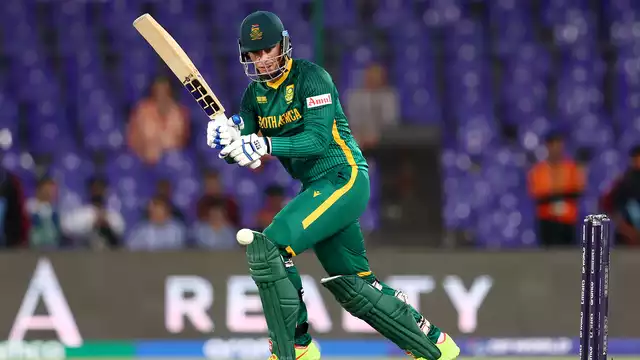
Rassie van der Dussen’s story has always been about far more than numbers on a scorecard. It is about identity, timing, resilience, and a quiet authority that rarely seeks the spotlight but often defines it. In South Africa, where names carry history and culture in equal measure, even something as simple as a nickname can tell a story. For those named Erasmus, “Rassie” is almost inevitable. Yet while rugby has long been associated with the famed coach Rassie Erasmus, cricket found its own version in Hendrik Erasmus van der Dussen — a man who carved out a legacy not through noise, but through consistency, clarity, and conviction.
When van der Dussen announced his retirement from international cricket, it felt less like the end of a career and more like the closing of a chapter defined by maturity and meaning. His departure leaves a void that statistics alone cannot measure. Yes, he was among South Africa’s most reliable batters in white-ball cricket, peaking at fourth in the ICC T20I rankings in 2021 and climbing to second in the ODI rankings a year later. Yes, he scored centuries under pressure, including memorable knocks in the 2023 World Cup. But what truly set him apart was the manner in which he carried himself — calm, thoughtful, and deeply aware of the responsibility that came with wearing the Proteas badge.
Van der Dussen’s batting was a reflection of his personality. There was nothing flamboyant or reckless about it. Instead, it was built on precision and control. When he struck the ball cleanly, it produced a sound that was unmistakable — sharp, authoritative, almost poetic in its intensity. It was the kind of sound that lingered, much like his innings. His strokeplay wasn’t just about scoring runs; it was about imposing a sense of order in chaotic situations. Whether anchoring an innings or accelerating when needed, he understood the rhythm of the game in a way that few modern players do.
Yet his journey to international cricket was anything but straightforward. Unlike prodigies who are fast-tracked into the national setup, van der Dussen had to wait. He played hundreds of matches across formats and levels before finally earning his South Africa debut. By the time he arrived on the international stage, he was already a finished product — technically sound, mentally tough, and emotionally grounded. That late entry, often seen as a disadvantage in modern sport, became his greatest strength. He knew what it meant to fight for an opportunity, and he never took it for granted.
His performances in the 2023 World Cup perhaps best encapsulated his value. Against a formidable New Zealand attack featuring some of the finest bowlers in the world, he produced an innings of 133 off 118 balls. It was not just the runs that mattered, but the context — the pressure, the expectations, and the stage. He rose to the occasion with a composure that spoke volumes about his character. It was batting with both skill and intellect, a combination that made him indispensable to the team.
But van der Dussen’s impact extended well beyond the boundary ropes. In a South African team that has navigated significant challenges in recent years — from the disruptions of COVID-19 to the broader social conversations around race and identity — he emerged as a steady voice in the dressing room. He was not the loudest presence, but he was one of the most respected. When he spoke, people listened, not because he demanded attention, but because he earned it.
His words during the 2023 World Cup, reflecting on the team’s journey through adversity, offered a glimpse into his mindset. He spoke of unity, of connection, of the importance of understanding one another beyond cricket. In a team shaped by diverse backgrounds and experiences, he recognized the value of empathy and cohesion. It was leadership in its purest form — not about authority, but about influence.
That sense of responsibility also defined his relationship with the Proteas badge. For van der Dussen, representing South Africa was never just about personal achievement. It was about honoring a legacy, a family, and a nation. Growing up with his brothers, the game was more than a pastime; it was a shared passion that shaped their lives. To be the one who carried that dream onto the international stage was both a privilege and a duty. He embraced it fully, aware of the sacrifices it required and the rewards it offered.
His retirement statement captured that भावना beautifully. It was not filled with grand declarations or dramatic farewells. Instead, it was sincere and reflective, rooted in gratitude. He acknowledged the people who supported him — teammates, coaches, administrators, friends, and family. He spoke of his wife, Lara, and the role she played in his journey. He thanked the fans, whose voices turned moments on the field into memories that would last a lifetime.
Those moments were as diverse as South Africa itself. The chant of “MaThousand” echoing through the streets, a song that celebrates milestones and gratitude, represented one side of the country’s cultural tapestry. The roar of “Antibiotika” at the Wanderers Stadium, with its raw and unapologetic energy, represented another. Between those two extremes lay the reality of modern South Africa — complex, layered, and constantly evolving. Van der Dussen navigated that space with a quiet understanding, never shying away from its challenges, yet never losing sight of its beauty.
To say that he “embodied what it meant to be a Protea,” as Cricket South Africa’s leadership noted, is not mere sentiment. It is an acknowledgment of the values he brought to the team — integrity, resilience, and selflessness. He was the kind of player who put the team first, who supported those around him, and who led by example. In an era where individual brilliance often takes center stage, his approach was refreshingly collective.
And yet, there was nothing simple about being Rassie van der Dussen. His career unfolded against the backdrop of a changing nation, where questions of identity and belonging are ever-present. He understood that representing South Africa meant engaging with those realities, not ignoring them. Whether through his words or his actions, he demonstrated a willingness to be part of that conversation, to contribute in his own way.
As he steps away from international cricket at the age of 37, he does so with a sense of completeness. There are no lingering “what ifs,” no unfinished business. He gave the game everything he had, and in return, it gave him a platform to make a difference. His legacy will not be defined solely by his runs or his rankings, but by the impact he had on those who shared the dressing room with him and those who watched from the stands.
The sound of his bat — that sharp, unmistakable crack — may no longer echo in South Africa’s matches, but its memory will endure. It is a reminder of a player who combined skill with substance, who balanced performance with perspective, and who understood that cricket, like life, is about more than just outcomes.
In many ways, van der Dussen’s story is a testament to the idea that greatness does not always arrive early or loudly. Sometimes, it takes time. Sometimes, it is built quietly, piece by piece, through perseverance and purpose. And sometimes, it leaves just as quietly, with a simple message of gratitude and a legacy that speaks for itself.
He may be done with international cricket, but he is far from done with the world beyond it. That is where his story continues — not as a cricketer, but as a person shaped by the game and the country he represented. And if his career has shown anything, it is that he will approach that next chapter with the same thoughtfulness and integrity that defined his time in green and gold.