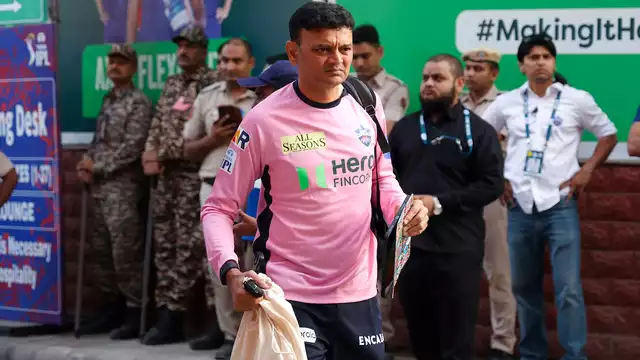
The landscape of cricket coaching is undergoing a subtle yet powerful transformation, and at the center of this shift stands Hemang Badani—a figure whose journey reflects the growing global footprint of Indian coaches. In the context of the Indian Premier League 2026 season, where only a handful of head coaches are Indian, Badani’s presence is not just notable—it is symbolic of a broader evolution that has been quietly gathering momentum over the past decade.
Badani’s coaching résumé is both diverse and impressive. From his success in the Tamil Nadu Premier League to making a mark in the International League T20 with the Dubai Capitals, he has steadily climbed the ranks. Add to that his contributions to multiple title-winning campaigns in the Lanka Premier League and his role in the triumph of Sunrisers Eastern Cape in the SA20, and it becomes clear that his journey has been anything but conventional. Now, as he prepares for his second season with the Delhi Capitals and a new assignment with Southern Brave in The Hundred, Badani finds himself operating across three major franchise ecosystems—a rare and significant achievement for an Indian coach.
What makes this journey particularly compelling is that it was never meticulously planned. Badani himself admits that coaching was not a career path he had envisioned early on. His entry into coaching came almost by accident during his time in the TNPL. Yet, what began as an opportunity gradually turned into a calling. The TNPL served as a foundational platform, allowing him to understand the nuances of coaching, experiment with ideas, and most importantly, learn how to connect with players.
This organic progression highlights a critical aspect of modern coaching—the importance of adaptability. Unlike traditional perceptions where coaches were seen as authoritative figures dictating instructions, Badani represents a more contemporary approach. He emphasizes listening as much as speaking, understanding as much as instructing. In his view, coaching is not a one-way process but a dynamic exchange of ideas. This becomes even more crucial when dealing with professional cricketers who bring their own experiences, insights, and methods to the table.
One of Badani’s greatest strengths lies in player management. Over time, he has developed the ability to provide clarity without imposing rigidity. He recognizes that each player is unique, with different mental frameworks, technical approaches, and emotional needs. His role, therefore, is not to enforce a uniform style but to enhance individual strengths while aligning them with the team’s objectives.
This philosophy is particularly relevant in today’s cricketing ecosystem, where players participate in multiple leagues across the globe. A modern cricketer might play in four or five different tournaments in a year, working under different coaches and adapting to varying roles. As Badani points out, this creates a complex environment where role clarity becomes paramount. A player who is asked to play aggressively in one league might be required to anchor the innings in another. Managing these transitions requires not just tactical awareness but also emotional intelligence.
Badani approaches this challenge with a pragmatic mindset. Instead of trying to overhaul a player’s technique in a short span—often limited to just a few days before a tournament—he focuses on defining roles and maximizing existing strengths. This approach acknowledges the realities of franchise cricket, where time is a luxury and immediate performance is the priority.
Another dimension where Badani’s Indian background becomes an advantage is cultural understanding. He believes that an Indian coach can often connect more deeply with Indian players due to a shared cultural context. This connection goes beyond language—it encompasses an understanding of the player’s journey, upbringing, and the unique pressures they face. For instance, an Indian coach is more likely to have insights into a domestic player’s early career, having followed their progress through age-group cricket and state-level competitions.
However, Badani is quick to clarify that cultural familiarity is not a prerequisite for effective coaching. Communication remains the key. Whether working with Indian players like Axar Patel or international stars such as Tristan Stubbs, the fundamental principle remains the same—build trust through clear and honest communication. Once that trust is established, the coach-player relationship becomes a collaborative partnership.
Trust, in fact, is the cornerstone of Badani’s coaching philosophy. He believes that the initial days of a tournament are crucial for establishing this bond. Simple conversations, openness to feedback, and a genuine interest in the player’s well-being can go a long way in breaking barriers. When players feel comfortable enough to question, challenge, and engage in discussions, it indicates a healthy relationship—one that is essential for sustained success.
The rise of Indian coaches like Badani also raises an important question: why has it taken so long for franchises to embrace local coaching talent? Historically, cricket coaching has been dominated by figures from countries like Australia, England, and South Africa. This trend was partly due to the lack of structured coaching pathways in India. Former players often transitioned into commentary or administrative roles, with limited opportunities to develop as professional coaches.
Over the years, this scenario has changed significantly. The emergence of domestic leagues, the expansion of franchise cricket, and the increasing professionalization of the sport have created new avenues for coaching development. Figures like Rahul Dravid, Gautam Gambhir, Ashish Nehra, and Chandrakant Pandit have demonstrated that Indian coaches can succeed at the highest level. Their achievements have helped shift perceptions and opened doors for the next generation.
The role of the Board of Control for Cricket in India has also been significant in this transition. By increasingly backing Indian coaches for national and domestic roles, the board has created a pathway for local talent to gain experience and credibility. This, in turn, has made them more attractive to franchise teams around the world.
Looking ahead, the possibility of Indian coaches taking charge of international teams no longer seems far-fetched. Badani points to examples like Sridharan Sriram, who has already been involved with overseas setups, as evidence that the barriers are gradually being dismantled. In a globalized cricketing environment, coaching is becoming less about nationality and more about competence and results.
This shift mirrors trends seen in other sports, where coaches frequently cross national boundaries. Figures like Brendon McCullum and Trevor Bayliss have successfully coached teams outside their home countries, reinforcing the idea that coaching is a universal profession. For Indian coaches, the challenge is not just to secure opportunities but to sustain success in highly competitive environments.
Badani emphasizes that humility is a critical trait for any aspiring coach. Past achievements as a player, while valuable, do not guarantee success in coaching. The focus must always remain on the players and their development. A coach’s role is to support, guide, and facilitate—not to dominate or seek the spotlight. This mindset is particularly important in franchise cricket, where egos can clash and managing personalities becomes as important as strategizing for matches.
Another interesting trend is the emergence of multi-league coaching roles within the same franchise network. With IPL franchises expanding into other leagues, there is a growing preference for continuity in coaching staff. Coaches who are familiar with the franchise’s philosophy and management style are often entrusted with roles across different teams. This not only ensures consistency but also allows coaches to build long-term relationships with players.
Badani’s association with both Delhi Capitals and Southern Brave is a prime example of this model. It reflects a broader strategy where franchises invest in coaches as long-term assets rather than short-term appointments. For coaches, this opens up opportunities to work in diverse conditions, interact with a wide range of players, and continuously refine their skills.
The future of coaching, particularly for Indian professionals, appears promising. The barriers that once limited opportunities are gradually being removed, replaced by a more meritocratic system. As franchise cricket continues to expand, the demand for skilled coaches will only increase. Indian coaches, with their deep understanding of the game and growing international exposure, are well-positioned to capitalize on this demand.
However, the journey is not without challenges. The coaching market is highly competitive, and performance remains the ultimate benchmark. Opportunities may arise, but sustaining them requires consistent results and the ability to adapt to different environments. For Indian coaches aspiring to make a mark globally, the key lies in continuous learning, openness to new ideas, and an unwavering commitment to excellence.
In many ways, Badani’s journey encapsulates the essence of this evolving landscape. From an unplanned entry into coaching to becoming a sought-after figure across multiple leagues, his story is both inspiring and instructive. It underscores the importance of perseverance, adaptability, and a player-centric approach.
As the cricketing world becomes increasingly interconnected, the role of the coach is evolving from a tactical advisor to a holistic mentor. The ability to manage diverse personalities, navigate cultural differences, and foster a positive team environment is becoming as important as technical expertise. Indian coaches, with their unique blend of experience and perspective, are beginning to carve out a space in this new paradigm.
The rise of figures like Hemang Badani is not just a personal success story—it is indicative of a broader shift in the global cricketing ecosystem. It signals a future where Indian coaches are not just participants but leaders, shaping teams and influencing the game at the highest level. And if current trends are anything to go by, this is only the beginning of a new and exciting chapter for Indian cricket coaching.