WORLD / US President Donald Trump has declared that Iran is now “negotiating on fumes”, signalling growing confidence inside the White House that a diplomatic breakthrough may be close despite mounting political and economic pressure surrounding the ongoing conflict.
Speaking during a Cabinet meeting, Trump insisted that the upcoming US midterm elections would not influence his decisions on the nearly three-month-long confrontation with Iran, which has unsettled global markets and fuel prices.
“They thought they were gonna outwait me,” Trump said while referring to Iranian leaders. “You know, ‘We’ll outwait him. He’s got the midterms.’ I don’t care about the midterms.”
The remarks came as the administration continues high-stakes negotiations aimed at ending hostilities and reopening the Strait of Hormuz, one of the world’s most critical oil shipping routes.
The narrow waterway carries a major share of global oil exports, and disruptions linked to the conflict have fuelled fears of rising energy prices, inflation and broader economic instability worldwide.
Trump has increasingly suggested that a deal with Tehran may be within reach. Over the weekend, he claimed that Washington and Tehran had “largely negotiated” a settlement, though officials acknowledge that key parts of the agreement remain unresolved.
According to reports, the proposed arrangement would temporarily reduce tensions while launching further negotiations on Iran’s nuclear programme, sanctions relief and regional security issues.
For Trump, securing a deal could provide a political opportunity to declare that Iran’s nuclear capabilities have been weakened enough for the United States to claim victory and reduce the risk of a wider regional war.
However, the strategy also carries serious political risks.
Critics from both parties — including some Republicans — have warned that the emerging agreement may leave many core issues unresolved while allowing Iran’s leadership to survive politically and militarily despite months of conflict.
Some conservative voices argue that Tehran could emerge weakened but ultimately emboldened if sanctions are eased or military pressure is reduced without permanent restrictions on its nuclear activities.
The criticism reflects long-standing divisions within American politics over how to deal with Iran. Hard-line Republicans have traditionally supported maximum military and economic pressure, while others favour diplomacy to avoid another prolonged Middle East conflict.
Trump now faces pressure from multiple directions. On one hand, many voters are weary of foreign wars and rising economic uncertainty. On the other, critics accuse the administration of potentially settling for an incomplete agreement that may only delay future confrontations.
The political stakes are particularly high because the conflict has already become unpopular among sections of the Republican base. Concerns over fuel prices, inflation and economic instability are increasingly shaping voter sentiment ahead of the November midterm elections, which will determine control of Congress.
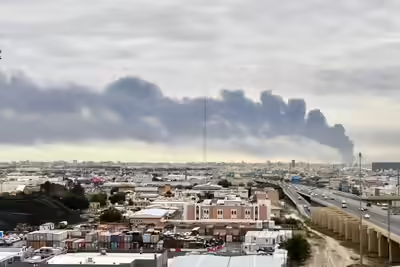
Rising oil prices linked to instability in the Gulf region have also added pressure on the White House. Any prolonged disruption in the Strait of Hormuz could trigger further increases in energy costs globally, affecting consumers and businesses alike.
Despite these concerns, Trump sought to project confidence and independence from political calculations. By insisting he does not care about the midterms, the president appeared determined to frame his Iran strategy as driven by national security rather than electoral politics. Still, analysts say domestic political realities remain deeply connected to the conflict’s outcome.
If Trump secures a ceasefire or diplomatic agreement that stabilises oil markets and avoids a wider war, it could strengthen his image as a dealmaker capable of managing international crises. But if negotiations collapse or violence resumes, the administration could face criticism for failing to achieve a decisive result after months of military pressure and diplomatic manoeuvring.
The conflict has also exposed divisions within Trump’s own political coalition. Some supporters have questioned why the administration became deeply involved in another Middle East confrontation despite Trump’s previous promises to avoid costly foreign wars. Others argue that failing to fully dismantle Iran’s nuclear infrastructure would represent a strategic mistake that could create even bigger security challenges in the future.
Meanwhile, Iranian officials continue to negotiate cautiously while demanding sanctions relief and guarantees regarding frozen financial assets. Tehran has repeatedly insisted that any lasting agreement must recognise Iran’s security interests and reduce external pressure on its economy.
Diplomatic efforts involving mediators such as Qatar and Pakistan are continuing behind the scenes, though uncertainty remains over whether both sides can bridge major disagreements. For now, Trump appears focused on balancing military pressure with diplomatic flexibility — seeking a deal strong enough to present as a victory while avoiding a broader war that could damage both global stability and his political standing at home.
As negotiations continue, the outcome may shape not only the future of US-Iran relations but also the political landscape heading into one of America’s most closely watched midterm elections in years.